CertaGrid Health
Who actually buys inside surgical facilities, read from the public record
For companies that sell into surgery centers, hospital outpatient surgery, and the physician practices around them
Dignity Health, Maricopa County: twenty-two centers wear the USPI mark, Tenet lists twenty, and none is a Dignity account
Twenty-two surgery centers carry the USPI mark in the directory of Dignity Health's provider network. The buying decision is Dignity's at none of them, and sixteen are one account. This map ranks the centers by how far the buying decision sits from the name on the door, names the door at each of seven accounts, and gives each center's 2024 Medicare patient count.
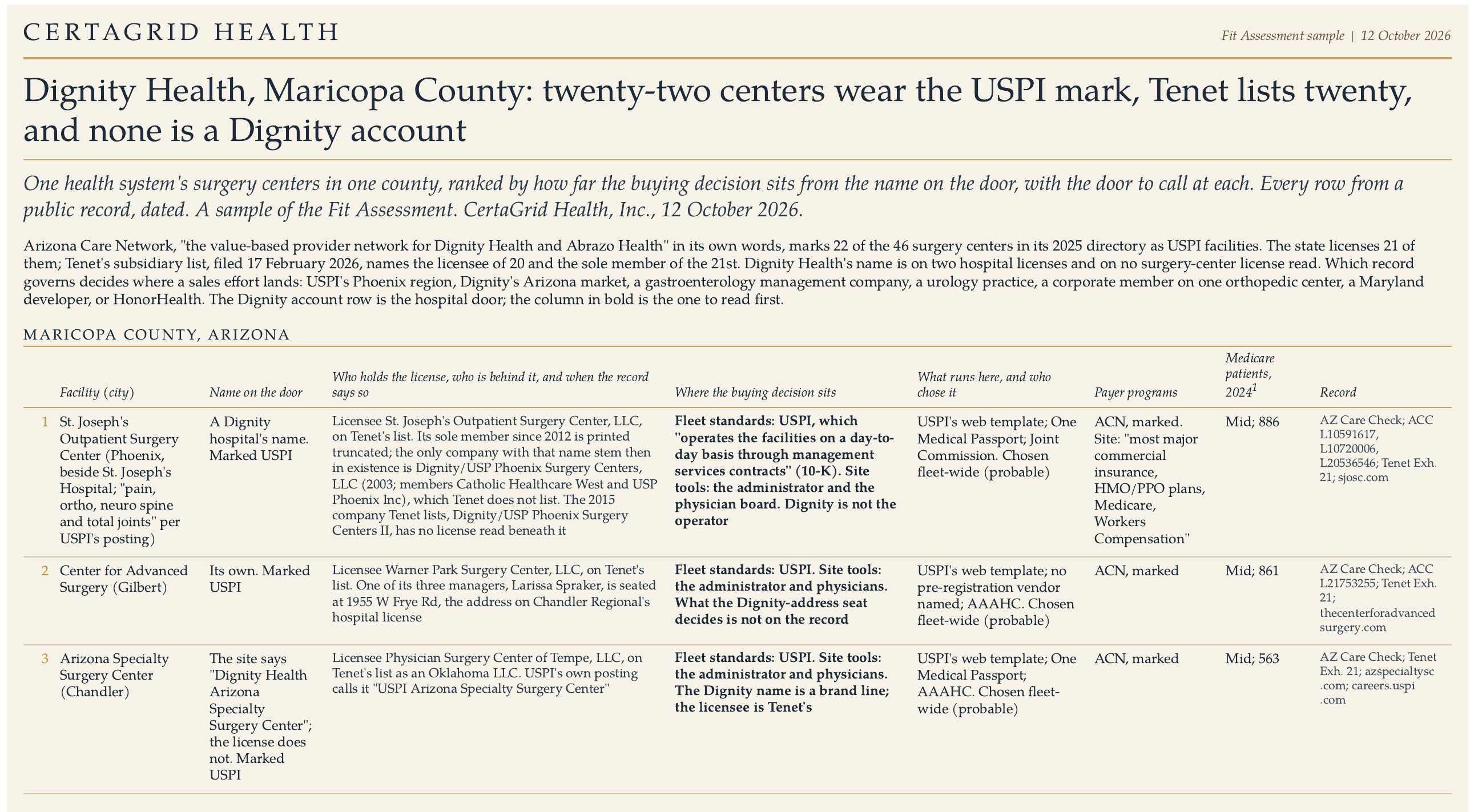
The first sample, September 2026
Advocate Health, Illinois: eight surgery centers, one name, four buyers
Eight centers carry the system's name. Four different buyers sit behind them, and the largest by site count is in Birmingham, Alabama. This page ranks them by how far the buying decision sits from the name on the door, and names the door to call at each. It was read from the public record in two days.
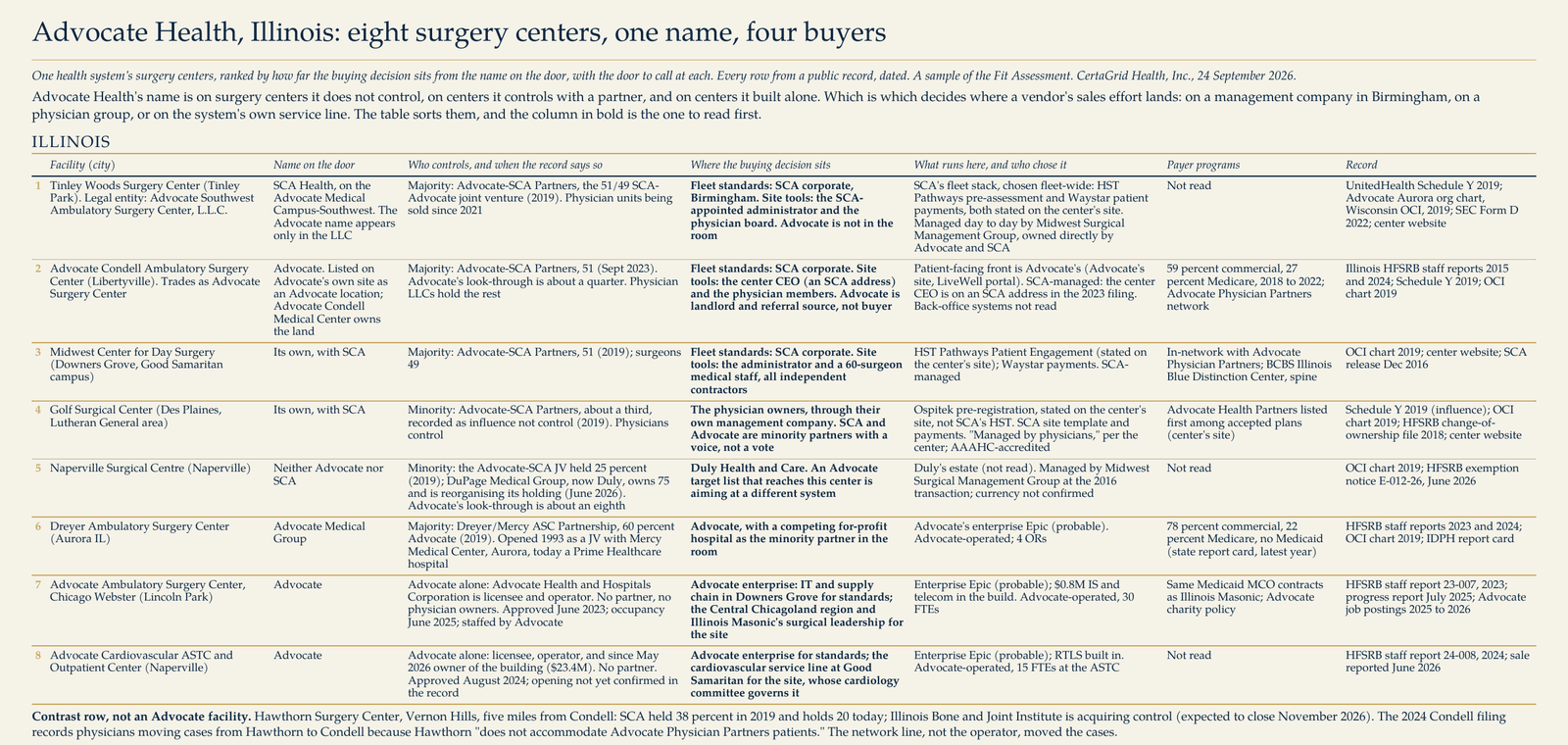
The Fit Assessment
If you sell into surgical facilities, your sales cycle turns on one question: who can say yes. The answer depends on who owns the facility. A center a management company controls is one sale. A center it shares with a health system and the surgeons is another. A center the surgeons own is a third. The name on the door does not tell you which, and neither does the system's website. The owners' own filings do.
The assessment is the pages above, for every system on your target list, and then the view across them. You get:
- One map per system and market. Every surgical facility that carries the system's name in the state or region you name, who controls it and since when, what already runs in the building, which payer programs sit in front of it, how many Medicare patients it saw last year, and the record behind each row.
- The accounts, ranked. Which systems are one enterprise buyer, which are three buyers wearing one name, and which are really a management company's fleet. A target list of nine systems is often four accounts.
- The door at each account. Who holds the decision for fleet standards and who holds it for a tool that lives in one specialty's workflow, what to bring, and who to call second.
- The ledger. Every source, every status, so a claim on the page can be checked against the document rather than taken on my word.
Scoped by system and market, from one county to a set of states. The fee and the delivery date are fixed once I have counted the record, and never vary with the finding; half on go-ahead and half on delivery. You retain the work. It takes no position on your product and names no customer of the systems it reads. I do not sell to the facilities, take referral fees, or work for a competitor of yours while your assessment is open.
Discuss an assessment
Tell me what you sell and the systems or states you are working. I will tell you whether the read is worth commissioning, and what it would cost, before you commit to anything.
Email founder@certagridhealth.comHow it runs
- 1Conflicts check. Before anything is discussed in substance, I check your company and your named targets against current and prior work. If there is a conflict, I say so and decline. This takes two business days.
- 2Scoping. Which systems, which states, and what you sell. The fee is fixed in advance and never varies with the finding.
- 3The reading. State licensing and corporation records, certificate-of-need files, insurers' statutory filings, the systems' own charts filed with state regulators, operators' subsidiary lists filed with the SEC, CMS's Medicare files, and the centers' own sites. Public record only; nothing non-public is used or sought.
- 4Delivery. The pages, the ranking, the doors and the ledger, on the date fixed at scoping, with a call to walk through where to aim first.
This is independent structural analysis. It is not legal advice, a legal opinion, or sales consulting, and it complements the market knowledge your team already has.
Where the method comes from
The reading behind the pages above is published. Four volumes set down the instruments that read a consolidation arrangement's representations against what it operationally does, and The Healthcare Structural Review applies them weekly to the filings of named platforms. Before founding the firm I spent more than twenty years inside health systems and payer organizations, in market analysis and competitive intelligence at Kaiser Permanente and in strategy and operations roles there and at PeaceHealth. The volumes, the newsletter and the firm's other independent engagements are on a second page.
Stay informed
About the founder
CertaGrid Health was founded by Scott C. Williams, who serves as President and Founder. Williams brings more than 20 years of healthcare strategy and operations experience, including leadership roles at Kaiser Permanente (Hawaii and Georgia Regions) and PeaceHealth, where his work spanned strategy, operations, market analysis, and competitive intelligence. His analytical framework draws on extensive operational experience inside health systems and payer organizations. Williams is a former United States Marine Corps officer.
Contact